published 5 and more posts
Andrew Parrock
Sally East
Pradip Shroff
Epimetheus
Lilian Abrams
Martin Richards
Maria Biquet
Simon Dennis
Katy Tuncer
Ian Flanders
Simon Darnton
Geoffrey Ahern
Alan Robertson
Isobel Gray
Laurent Terseur
Aubrey Rebello
Lynne Hindmarch
Doug Montgomery
Sue Young
Jeremy Ridge
Naomi Dishington
Wendela Wolters
Nicholas Wai
Charlotte Murray
Yvonne Thackray
Yvonne Thackray (MSc, MEng, APECS) is an executive coach and peer supervisor, and a practitioner researcher and editor, who has combined her passions through all these roles for the past decade. Yvonne has lived and worked in both the UK and Hong Kong. She works with clients internationally, with a keen interest in leadership (professional and personal) and knowledge management (Intuition and tacit knowledge).
A specialist in the field of coaching she defines coaching as providing that quality of attention that enables another person to have the confidence and clarity to reach and humbly manage their potentials now and in the future. She has a reputation for being prepared, patient and thorough, a sharp listener and a good strategist for the way the conversation, or process, needs to be designed to ensure buy in.
Yvonne is fascinated by the potential of coaching, and how everyday practitioners practice their coaching approach in various situations and contexts. As founder of the good coach, she works with a team of like-minded practitioners to grow and develop a practitioner research institute whose core proposition is to understand what is coaching. She has also published three books, 40+ blogs, and articles.
In the coaching context, time is both a parameter and a container for reflection that spans the duration of the continuing lived experiences that is drawn to attention, a space for learning-unlearning-(re)learning, realising growth and development, and continuing developing character within a series of timed scheduled events.
I hope that everyone has had a good start to 2023 and that several readers and members have enjoyed the quick succession of welcoming in the western and lunar (Chinese) new year! It feels like 2023 starts now for many as they come off what might be considered a 'normal' break. Firstly, we're delighted to share the following three blogs we're looking forward to publishing from next week and making the good coach's announcement for change in 2023…
Recently a peer, who has worked in leadership development for almost two decades and holds a doctorate, reached out and asked a question about a challenge involving another coach which they considered to be an ethical issue. It was clear in their mind that the situation shouldn’t be taking place, especially as they are also trained as a therapist and the type of dynamic involved would never be allowed. With their permission, I asked if I could summarise their question/observations and share here after writing my response to their important challenge.
Peer supervision is an integral part of our practice. We have had between 6 to 8 hourly supervision sessions a year for the past few years and value the expertise in each of our coaching markets to provide the necessary space to check our fitness to practice. Our ultimate agenda when we participate in our sessions is to check our fitness to practice.
Understanding that curiosity is one of the basic traits needed for survival has been a paradigm shift for me, my coaching practice, and my education because it addresses how I have intuitively applied curiosity in my coaching practice with my clients to enable their potential. In Part 2, I’ll go into more detail of how curiosity manifests itself in my work as a coach and the approach I’ve used to write up these experiences for curious coaching practitioners to consider as part of their own continuing professional and personal development.
Understanding that curiosity is one of the basic traits needed for survival has been a paradigm shift for me, my coaching practice, and my education because it addresses how I have intuitively applied curiosity in my coaching practice with my clients to enable their potential. In Part one, I describe why curiosity is important in my practice, and in Part two, I will explain how curiosity unfolds and emerges though my work as a coach.
The results shared in this report aims to fill in key gaps on what it takes to be a coach, and what’s involved in having a sustainable career in coaching. Where useful, we’ve also added some key insights and frameworks for coaches to consider alongside their own practice.
For Maria and Yvonne, after working for a combined years of 20+ years and collectively over 350 clients around the world, it’s been a while since we’ve taken those training wheel off and in each of our ways moved to that curiosity stage of all the different components that makes coaching coaching. We wanted to share from our experiences some of the myths we hold that when we begin to explore in more detail, that there is more to consider than what meets the eye.
As I stepped back to further reflect on what I’ve written, and integrating them with my recent experiences of coaching, I began to evaluate my style of coaching and what could be underpinning my approach. The key word that continuously popped up for me was ‘character’.
The pandemic has provided an opportunity for coaches to re-evaluate and take stock of the practice and business and determine how they want to deliver coaching. Coaching is often described as the 'Wild West' because it has a perception that many who come into coaching consider that it's easy to earn money in coaching, versus those people who are coming to coaching to deliver something of value through coaching.
Feedback is especially useful to further understand how I am developing my coaching style and approach. From my clients’ feedback, there is a general acknowledgement to my depth and breadth of knowledge, understanding of coaching, and how I flexibly apply it to meet my client’s challenges.

Having the opportunity to year-on-year publish a new book as part of the ‘Translating Coaching Codes of Practice’ series gives the good coach community both validation and confidence that the good coach approach is making positive headway in delivering a sustainable and robust approach that is slowly reaching its vision; to touch 1 percent of the global population with inspiring, and effective, coaching conversations.
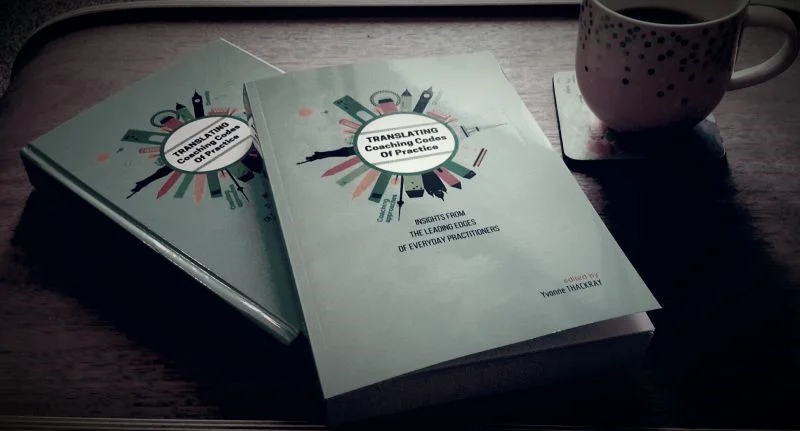
In our second book, Translating Coaching Codes of Practice: Insights from the Leading Edges of Everyday Practitioners, we began ‘growing’ a collection of coaching knowledge drawn from everyday practitioners. They had already made their transition into coaching were now focused on their practice and curious about how they had confidence in their coaching approach. In this edited collection, they shared their insights.
There really is no one way to do coaching because we each have our own unique ways of caring for, and paying attention to, the needs of our clients when we coach. However, when we talk about what attracts each of us to do coaching
A lot of my work in coaching is helping professionals reframe their understanding of the work they do in comparison to similar value work in the market place. MAKING PROGRESS AS A PROFESSIONAL
Coaching as we understand it today is part of an evolutionary process in elevating human potential. As societies continue to realize that each individual has greater potential to live beyond their limitations, coaching has tapped into that growing awareness while filling a gap left by the decline of lifelong structured developmental experiences like guilds, formal mentoring, and initiations.
Having the opportunity to year-on-year publish a new book as part of the ‘Translating Coaching Codes of Practice’ series gives the good coach community both validation and confidence that the good coach approach is making positive headway in delivering a sustainable and robust approach that is slowly reaching its vision; to touch 1 percent of the global population with inspiring, and effective, coaching conversations.
Yvonne Thackray